Updated: October 2026 | By Virendra Rathore, Founder — JoinFilms Academy
Short answer: Is acting talent or skill? For most actors it is mostly skill. Talent gives you a starting point — sensitivity, imagination, a natural ease in front of people — but the things casting directors actually judge (dialogue delivery, camera awareness, voice control, listening, consistency across takes) are trained through practice and feedback. Some people start ahead. But a sincere beginner who trains daily usually overtakes a "naturally talented" person who never practices. If you are asking whether acting can be learned, the answer is yes — with the right method and patience.
Why "Acting Talent or Skill" Is the Wrong Fight
Almost every week, a student messages us with a version of the same doubt: "Sir, mujhme talent hai ya nahi? Agar talent nahi hai to kya acting seekhna bekaar hai?" The question of acting talent or skill feels important because it seems to decide whether you should even try.
Here is the problem with that question. It treats talent as a fixed ticket — either you were born with it or you were not. In real auditions, nobody hands you marks for "talent". A casting director watches a 2-minute self-tape and asks simple questions: Is this person believable? Can they hold the frame? Can they repeat the same emotion in take five? Did they listen to the other actor? Each of those is a skill you can practice.
So instead of asking "acting talent or skill — which one do I have?", ask a better question: "Which parts of acting am I already good at, and which parts do I need to train?" That shift alone removes most of the fear.
What "Talent" Actually Means in Acting
When people say someone is "born talented", they usually mean a mix of these things:
- Emotional sensitivity — you feel things quickly and deeply.
- Imagination — you can picture a situation so clearly that your body reacts to it.
- Observation — you notice how people walk, pause, lie or hide nervousness.
- Low self-consciousness — you do not freeze when people watch you.
These are real advantages. But notice something: even these can be sharpened. Observation improves when you study people deliberately. Self-consciousness reduces with repeated exposure — every nukkad natak, every class performance, every self-tape makes the camera less scary. Talent is a head start, not a finish line. In the acting talent or skill debate, that head start is real but small.
And there is a hidden trap. "Talented" beginners often depend on mood. On a good day they are brilliant; on a tired day, on the fifth take, under bright lights, they fall apart. Professional sets need actors who can deliver on demand. That reliability comes only from technique.
Acting Talent or Skill: A Trait-by-Trait Table
To make the acting talent or skill debate practical, we broke acting into the abilities casting teams actually notice. This table is based on our classroom experience of training beginners — it is a guide, not a scientific measurement.
*Time estimates are our qualitative observation from training beginners, not a guarantee. Practice quality changes everything.
Look at the pattern. The abilities where natural talent matters most (emotional sensitivity) are only one row. Most of what gets you selected — camera awareness, consistency, dialogue delivery — depends almost entirely on training.
Video: 5 Things That Matter More Than Talent
In this JoinFilms video, Virendra Rathore talks about five things an aspiring actor can do instead of waiting to "discover" talent. Watch it with a notebook and write down which of the five you are already doing.
Real Proof: Actors Who Trained Their Way In
You do not have to take our word for it. Many respected Indian actors built their craft through years of formal training and theatre, not overnight "natural talent".
Nawazuddin Siddiqui studied chemistry and, according to Wikipedia, worked as a chemist in Vadodara for about a year. He got interested in acting after watching a play in Delhi, later trained at the National School of Drama, and graduated in 1999.
Pankaj Tripathi played small roles in his village's local plays, then moved to Delhi to study at the National School of Drama, graduating in 2004, as noted on Wikipedia.
We have also covered how Ayushmann Khurrana learned acting from theatre to camera and the Rajpal Yadav acting journey from Lucknow theatre and NSD. The common thread is not "born perfect". It is years of deliberate practice. In each of these stories, acting talent or skill was never an either-or choice — training turned potential into craft.
7 Lessons on Building Acting Skill
Whatever your answer to acting talent or skill, these are the lessons we repeat most often to new students:
- Practice daily, even 30 minutes. Read one scene aloud every day. Consistency beats occasional 5-hour sessions.
- Record and watch yourself. Your phone camera is your first teacher. Most beginners discover overacting only when they see playback.
- Train the voice separately. Breath, pace and clarity need their own routine — see our guide on voice modulation and diction for actors.
- Learn the camera, not just the emotion. Shot sizes, eyeline and stillness change how a performance reads. Start with natural acting for camera techniques.
- Use monologues as your gym. A monologue lets you practice alone. Our monologue practice tips show how to break one into beats.
- Get honest feedback. Friends say "badhiya tha". A trained mentor tells you what to fix.
- Measure progress in months, not days. Skill grows quietly. Compare your self-tape today with one from 90 days ago.
Practical Exercise: A 7-Day Skill Audit
This exercise helps you stop guessing about acting talent or skill and start seeing your real strengths.
Day 1–2: Baseline recording
Pick a short neutral scene (6–8 lines). Record it once on your phone at chest height, mid-shot, natural light from a window. Do not watch it yet.
Day 3–4: Score yourself
Now watch it. Score 1–5 on: clarity of voice, believability, eye focus, stillness, and whether you were listening (even to an imaginary partner). Write one sentence for each score.
Day 5–6: Train only the two weakest areas
If voice scored lowest, do 15 minutes of breathing plus reading aloud. If believability was low, write the character's backstory in five lines and replay the scene.
Day 7: Re-record and compare
Record the same scene again, same setup. Watch both side by side. Even small improvements in a week prove the point — the parts you trained moved. That is skill — and it is the clearest answer to the acting talent or skill question you will ever get.
Honest note: Training improves your craft, but no course, coach or blog can guarantee you a film role. Casting also depends on look, age range, timing, location and plain luck. Whatever your view on acting talent or skill, what training does is make sure that when an opportunity comes, you are ready for it. Be wary of anyone who promises guaranteed work for a fee.
Video: From Zero Experience to First Audition
If you are worried that you have "no talent and no experience", this episode of the Sach Bolo Sir series is a good next step. Virendra Rathore answers beginner questions on how to start, what the first step is, and what to do without experience.
Acting Talent or Skill Mindset Mistakes
The way you think about this question can quietly sabotage your progress. Watch out for these:
- "I'm talented, so I don't need classes." Raw talent without technique often shows up as overacting on camera. Our list of common on-camera mistakes new actors make is full of examples.
- "I'm not talented, so why try?" Most beginners feel awkward in their first recordings. Awkwardness is a stage, not a verdict.
- Judging yourself after one audition. Rejection usually says more about the role's requirements than your ability.
- Copying star mannerisms. Imitation feels like talent, but casting teams look for truthful behaviour, not a copy of someone famous.
- Practicing without feedback. Repeating the same mistake for months does not build skill — it builds habit.
Memory is another place where beginners blame "talent". Learning lines is pure technique — try the method in our guide on how to memorize dialogues fast for acting.
Where to Train: Courses and Next Steps
Once you settle the acting talent or skill question for yourself and decide to train properly, pick a format that fits your city, schedule and budget. If you are unsure, read our online vs offline acting course decision framework first.
FAQs: Acting Talent or Skill
❓ Is acting talent or skill?
Mostly skill. Natural sensitivity and imagination help, but dialogue delivery, camera awareness, voice control and consistency are trained through practice and feedback.
❓ Can anyone learn acting without natural talent?
Most people can learn to act believably with steady training. How far you go professionally also depends on dedication, look, timing and opportunities, so nobody can promise results.
❓ How do I know if I have acting talent?
Record a short scene, watch it honestly and score your voice, believability, focus and listening. Your strengths show where you have a head start; your weak areas show what to train.
❓ How long does it take to learn acting?
Basic camera comfort can improve within weeks of regular self-tapes. Deeper skills like emotional truth and consistency across takes usually take months or years of practice.
❓ Did famous Indian actors train formally?
Many did. For example, Nawazuddin Siddiqui and Pankaj Tripathi both trained at the National School of Drama before building their film careers.
❓ Is an acting course necessary to become an actor?
It is not mandatory, but structured training with feedback speeds up learning and helps you avoid common on-camera mistakes. Self-practice alone can work, though it is usually slower.
❓ Does acting talent or skill matter more in auditions?
Skill shows up more clearly in auditions. Casting teams notice whether you can deliver lines naturally, take direction and repeat a performance — all trainable abilities.
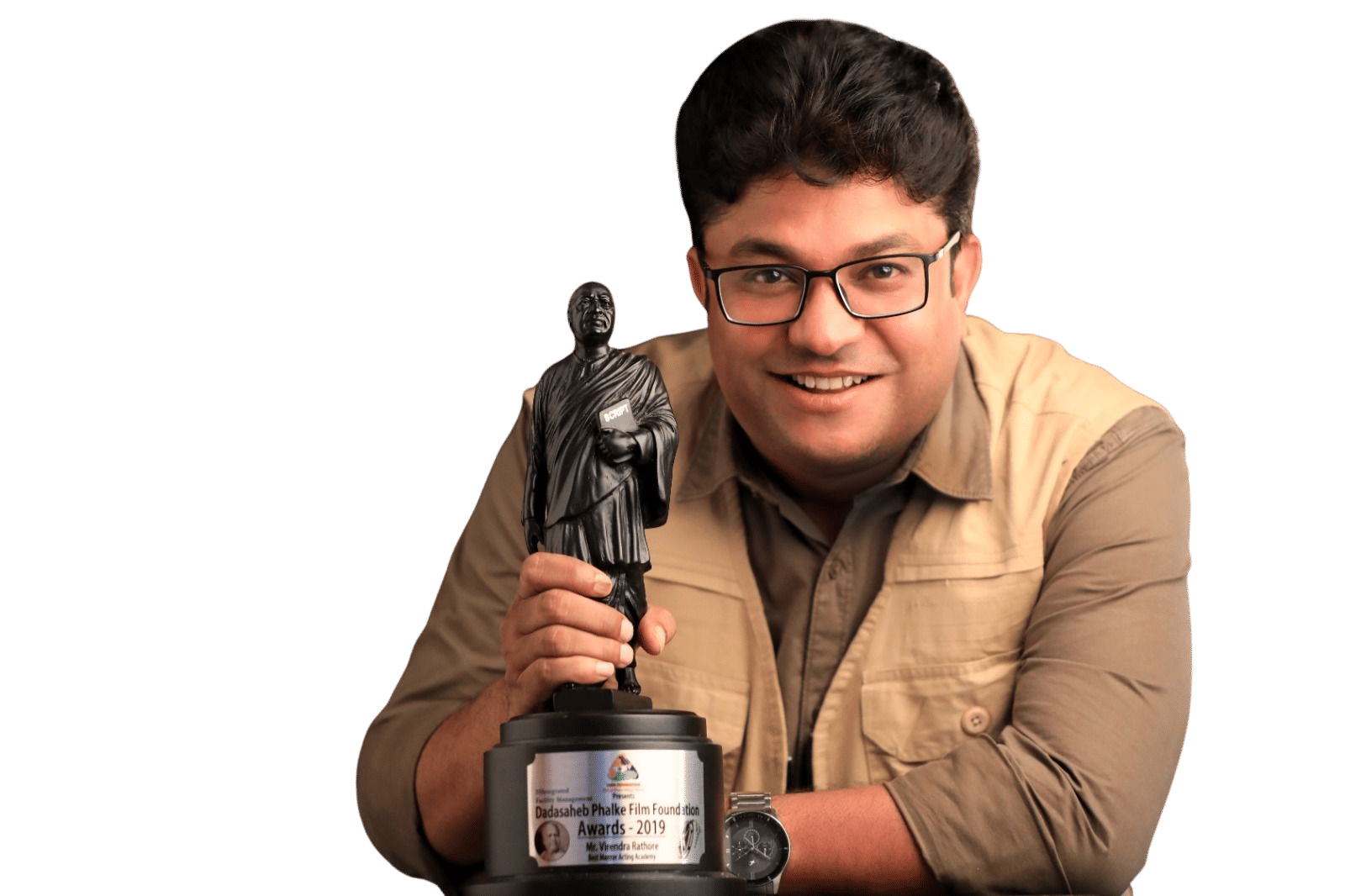
About the Author — Virendra Rathore
Virendra Rathore is the Founder and Chief Mentor of JoinFilms Academy. A Dadasaheb Phalke Film Foundation Award winner (Best Acting Mentor), IMDb-credited filmmaker, TEDx speaker, and bestselling author of the "Switch On Switch Off Acting Method," he brings over 25 years of active experience across acting, direction, and film education. Creator of JoinFilms — one of India's largest acting education communities, with over 2.9 million YouTube subscribers.
IMDb profile.
Career Guidance: Get Free Bollywood Career Guidance →
Sources: Nawazuddin Siddiqui — Wikipedia; Pankaj Tripathi — Wikipedia; Virendra Rathore — IMDb.
Related reads: Natural Acting for Camera · Monologue Practice Tips · Voice Modulation & Diction

 Launch your Graphy