Updated: October 2026 | By Virendra Rathore, Founder — JoinFilms Academy
Short answer: The Ayushmann Khurrana acting journey did not start at a film school. He learned acting through around five years of college theatre and street plays (nukkad natak) in Chandigarh, where he was a founding member of the DAV College theatre groups Aaghaaz and Manchtantra. He then built camera comfort through MTV Roadies (season 2 winner, 2004), radio jockeying at BIG FM and TV anchoring, before his film debut in Vicky Donor (2012), which won him the Filmfare Award for Best Male Debut. For aspiring actors, the lesson is clear: stage builds your foundation, but you still have to consciously learn how to scale your performance down for the camera.
Ayushmann Khurrana looks so natural on screen that many beginners assume he simply walked onto a film set and started acting. The real Ayushmann Khurrana acting journey is very different, and much more useful to study. It is a story of years of theatre rehearsals, nukkad natak competitions, reality television, radio shows and TV anchoring, all before a single film role came his way. Every one of those stages taught him a specific skill, and that is exactly why his performances feel so effortless today.
Ayushmann Khurrana Acting Journey: The Theatre Foundation in Chandigarh
Ayushmann was born on 14 September 1984 in Chandigarh. He studied at St. John's High School, then at DAV College, Chandigarh, where he majored in English literature. He later completed a master's degree in Mass Communication from the School of Communication Studies at Panjab University.
College is where the actual acting training happened. According to his Wikipedia and IMDb biographies, he did theatre seriously for about five years and performed in several plays at the Gaiety Theatre in Shimla. He was a founding member of two DAV College theatre groups, Aaghaaz and Manchtantra, and he won a Best Actor award for playing Ashwatthama in Dharamvir Bharati's classic play Andha Yug.
His team also conceived and performed street plays that earned recognition at major college festivals, including Mood Indigo at IIT Bombay and Oasis at BITS Pilani. Reports based on his own social media posts say his group's street play won first prize at Mood Indigo in 2002. For a small-city college group, that was a big deal, and it shows something important: he was not just "doing drama for fun". He was competing, getting judged and improving every season.
What Street Plays Actually Teach an Actor
Nukkad natak is one of the toughest acting schools in India, and it costs almost nothing. There is no stage, no lights, no microphone and no curtain. The audience is standing on the road and can walk away any second. That environment forces an actor to develop skills that many expensive courses struggle to teach:
- Voice projection and diction. Without a mic, every line has to reach the last person in the crowd clearly. This builds breath control and clean dialogue delivery.
- Body language and physical expression. Street theatre uses big gestures, group formations and physical storytelling, which trains an actor to use the whole body, not just the face.
- Audience connection. You learn to hold attention in real time and read the crowd's reaction instantly.
- Ensemble work. Street plays are team performances. You learn to listen, react and support your scene partners, which is the core of good acting.
- Writing and improvisation. Most college street plays are written by the team itself, so actors learn script structure, timing and how to improvise when something goes wrong.
Ayushmann himself has credited this phase. In a 2022 interview with Filmfare Middle East, he said: "Street theatre actually set my foundation to become a fearless performer." He also said it made him "not afraid to take risks" — which explains the unusual, bold scripts he later chose in films.
Notice that the same person who wrote and acted in street plays later wrote and composed the song "Paani Da Rang" (with Rochak Kohli, back in 2003) that became a hit in his debut film. Theatre made him a complete performer, not just a face reading lines.
Watch: Theatre vs Camera Acting — Which Makes You Better?
Virendra Rathore breaks down the real difference between stage acting and camera acting — the exact transition at the heart of the Ayushmann Khurrana acting journey:
Roadies, Radio and Anchoring — Building Camera Comfort
Theatre gave him craft, but camera acting is a different skill. On stage you play to the last row; in a close-up, the camera catches the smallest flicker in your eyes. Ayushmann's next few years, although not "acting" in the strict sense, quietly trained him for that shift.
In 2004 he won the second season of MTV Roadies, which put him in front of cameras for long hours with no script. His first proper job was as a radio jockey at BIG FM in Delhi, where his show "Big Chai – Maan Na Maan, Main Tera Ayushmann" earned him a Young Achievers Award in 2007. Radio is pure voice work: no face, no body, only tone, pauses and natural conversational delivery.
After that he moved into television anchoring, hosting MTV shows and co-hosting India's Got Talent on Colors TV. He also acted in the StarPlus series Kayamath in 2007. Anchoring taught him to talk to the lens as if it were a real person, stay relaxed with a crew around him and deliver lines naturally, which is exactly the "camera presence" that casting directors look for in auditions today.
The Vicky Donor Break and What Came After
His film debut came with Shoojit Sircar's Vicky Donor in 2012, where he played a sperm donor in a bold, unusual comedy. The film won him the Filmfare Award for Best Male Debut, and "Paani Da Rang", which he sang, also won him the Filmfare Award for Best Male Playback Singer.
What followed is a masterclass in script choices: Dum Laga Ke Haisha (2015), Bareilly Ki Barfi (2017), Badhaai Ho (2018), Article 15 (2019), Dream Girl (2019), Bala (2019) and Shubh Mangal Zyada Saavdhan (2020). He won the National Film Award for Best Actor for Andhadhun (2018), was named in Time's 100 most influential people in 2020, and appeared in Thamma in 2025. He has also written about his struggle years in his autobiography Cracking the Code: My Journey to Bollywood (2015), co-written with Tahira Kashyap.
The common thread in these roles is a believable, middle-class, small-town character. That believability comes directly from years of observing real people on the streets of Chandigarh while performing nukkad natak.
7 Lessons From the Ayushmann Khurrana Acting Journey
- Start where you are. He did not wait to move to Mumbai to begin training. College theatre in Chandigarh was his acting school.
- Compete and get judged. Festival competitions gave him honest feedback early. Look for open mics, inter-college fests and local theatre competitions.
- Build multiple skills. Acting, singing, writing and anchoring all fed into his career. Extra skills make you more castable.
- Learn the camera separately. Stage talent does not automatically translate to screen. Radio and anchoring helped him learn subtle, conversational delivery.
- Every job is training. Roadies, radio and hosting looked like detours, but each one sharpened confidence, voice and screen presence.
- Choose roles with a point of view. His filmography shows that script selection can define an actor's brand.
- Be patient. Roughly eight years passed between his Roadies win and his film debut. Most acting careers take time, and that is normal.
These lessons are our practical interpretation of his public career, not a guaranteed formula for success.
Watch: Struggling Actors and Practical Solutions
Ayushmann's years before Vicky Donor were a struggle phase like any other actor's. Virendra Rathore shares five practical steps for actors going through that same phase — auditions, networking, on-camera skills, moving to Mumbai and daily routine:
A Theatre-to-Camera Exercise You Can Do Today
Here is a simple drill that recreates the core transition of his career — from street-play scale to close-up scale:
- Pick one line, for example: "Mujhe bas ek mauka chahiye."
- Round 1 — Nukkad scale: Say it as if 50 people are standing around you on a road. Full voice, big gestures, open body.
- Round 2 — Medium shot: Say it to one friend sitting across a table. Normal voice, smaller movement.
- Round 3 — Close-up: Record it on your phone camera at face level, as if you are telling one person a secret. Let the thought show in your eyes before you speak.
- Watch all three recordings. Note what changed in your voice, eyes, breath and pauses.
Practise this with different emotions — desperation, anger, hope. Over time you will learn to control the "volume" of your performance consciously, which is the most important skill for any theatre actor moving into film, web series or ads.
Honest note: Theatre experience is a huge advantage, but it is not a requirement. Many actors start directly with camera training. What matters is consistent practice, honest feedback and learning to adjust your performance for the frame.
Applying the Ayushmann Khurrana Acting Journey Without a Theatre Group
Not every city has an active college theatre scene, and not everyone can join a drama group while studying or working. You can still follow the same principles:
Train Your Stage-to-Screen Skills — JoinFilms Academy
JoinFilms courses are built around the Switch On Switch Off Acting Method, which focuses on exactly the shift from big theatrical expression to truthful camera acting.
Frequently Asked Questions
❓ Where did Ayushmann Khurrana learn acting?
He learned acting mainly through about five years of college theatre in Chandigarh. He was a founding member of DAV College's theatre groups Aaghaaz and Manchtantra, performed at Gaiety Theatre in Shimla and did street plays at college festivals like Mood Indigo and Oasis.
❓ Did Ayushmann Khurrana go to an acting school?
His public biographies do not list a formal acting school. He studied English literature at DAV College and did a master's in Mass Communication at Panjab University, learning acting through theatre alongside his studies.
❓ What did Ayushmann Khurrana do before films?
He won MTV Roadies season 2 in 2004, worked as a radio jockey at BIG FM Delhi, hosted MTV shows, co-hosted India's Got Talent and acted in the TV series Kayamath before his 2012 film debut in Vicky Donor.
❓ What was Ayushmann Khurrana's first film?
His first film was Vicky Donor (2012), directed by Shoojit Sircar. It won him the Filmfare Award for Best Male Debut, and his song "Paani Da Rang" won Best Male Playback Singer.
❓ Is theatre necessary to become a film actor?
No. Theatre builds voice, body language and confidence, but many actors start directly with camera acting training. Theatre actors still need to learn to scale down their performance for close-ups.
❓ How can I learn acting like Ayushmann Khurrana if there is no theatre group in my city?
Practise monologues at home, record weekly self-tapes, train your voice and diction, join local workshops or college fests, and consider a structured online camera acting course with live feedback.
❓ How long did it take Ayushmann Khurrana to get his first film?
About eight years passed between his Roadies win in 2004 and his film debut in 2012, and his theatre years began even earlier in college. His journey shows that patience and continuous skill-building are part of an acting career.
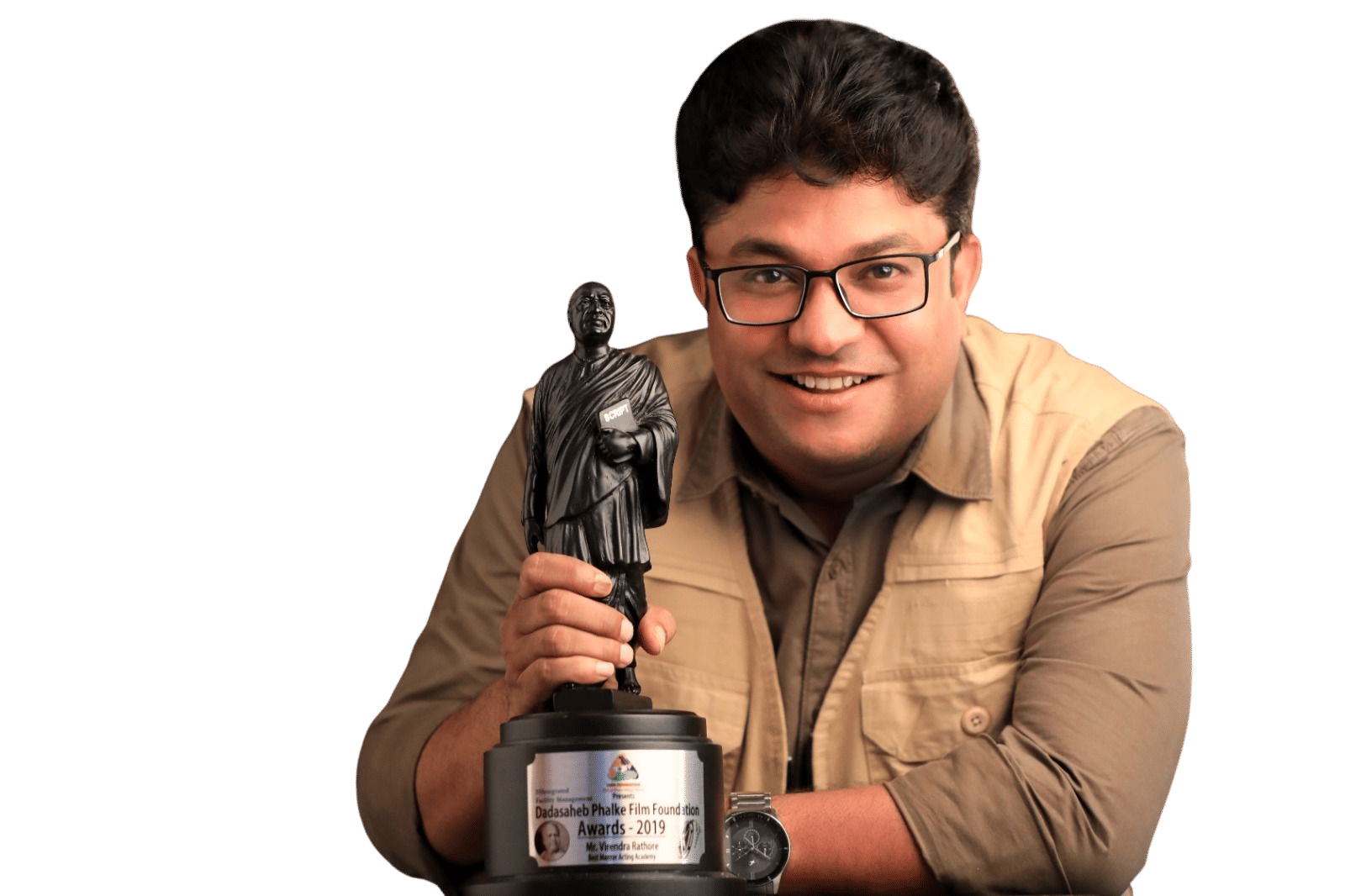
About the Author — Virendra Rathore
Virendra Rathore is the Founder and Chief Mentor of JoinFilms Academy. A Dadasaheb Phalke Film Foundation Award winner (Best Acting Mentor), IMDb-credited filmmaker, TEDx speaker, and bestselling author of the "Switch On Switch Off Acting Method," he brings over 25 years of active experience across acting, direction, and film education. Creator of JoinFilms — one of India's largest acting education communities, with over 2.9 million YouTube subscribers.
IMDb profile.
Career Guidance: Get Free Bollywood Career Guidance →
Sources: Wikipedia — Ayushmann Khurrana · IMDb — Ayushmann Khurrana · Filmfare Middle East (2022)
Related: Method Acting vs Meisner Technique · Professional Habits That Sustain a Long-Term Acting Career · Will AI Replace Actors? · JoinFilms on YouTube

 Launch your Graphy