
Common On-Camera Mistakes New Actors Make in India — And How to Fix Them (2026)
Updated: July 2026 | By Virendra Rathore, Founder — JoinFilms Academy
Short answer: The most common on-camera mistakes new actors make in India include looking directly into the lens, projecting at theatrical scale rather than camera scale, forgetting their floor mark, breaking continuity between takes, and arriving unprepared on lines. Every one of these mistakes is specific, learnable, and correctable with the right camera-focused training — they are not signs of insufficient talent, just gaps in camera-specific preparation.
Why New Actors in India Keep Making the Same Mistakes
Most acting mistakes on Indian film and OTT sets are not talent problems — they are training gaps. A significant number of aspiring actors in India train in theatre technique or general performance classes that never specifically address the practical, technical demands of working in front of a camera on an actual production.
The gap becomes visible the moment a new actor steps onto a real set — where marks, continuity, eyeline discipline, and camera scale are simply assumed knowledge by directors and crew. This guide breaks down the specific mistakes that repeatedly show up, and exactly what corrects each one.
8 Common On-Camera Mistakes New Actors Make
1
Over-Rehearsing Until the Performance Becomes Mechanical
New actors in India often over-rehearse a scene until every beat becomes fixed and predictable. On the actual shoot day, this produces a technically correct but lifeless performance — the director can sense it isn't alive, even if they can't immediately name why.
✅ Fix: Rehearse to understand the scene deeply, not to lock every choice. Leave room to genuinely respond in the moment on set.
2
Looking Directly Into the Lens Unless Instructed
This is one of the most common beginner mistakes on Indian film and TV sets. New actors instinctively glance at the camera, breaking the illusion of the scene and forcing multiple retakes.
✅ Fix: Train your eyeline discipline specifically during practice — know exactly where your scene partner or mark is at all times.
3
Projecting at Theatrical Scale for a Close-Up Camera
Actors with theatre backgrounds, or those trained without camera-specific instruction, often perform at a scale built for a large hall. On a close-up shot, this reads as exaggerated and unnatural.
✅ Fix: Practice specifically at camera scale — contained, internal, truthful. Record yourself and compare to how professional OTT actors calibrate their scale.
4
Not Knowing Their Mark on the Floor
New actors frequently forget or ignore the tape mark that defines their exact position for lighting and focus. This creates continuity problems and frustrates the entire crew, who then have to reset and re-explain.
✅ Fix: Practice hitting your mark without looking down at it — feel your position through rehearsal repetition before the camera rolls.
5
Breaking Continuity Between Takes
Small details — how a prop was held, which hand touched what, the exact gesture in the previous take — often shift unconsciously between takes. This creates expensive editing problems that can be avoided entirely.
✅ Fix: Make a mental or written note of specific physical choices immediately after each take, especially for props and hand positions.
6
Arriving Unprepared on Lines
Trying to learn lines on set, rather than arriving with them fully memorized, is treated as a serious professionalism issue by Indian production crews — and it consumes valuable, expensive shoot time.
✅ Fix: Lines should be completely memorized before call time, with enough security that you can adjust delivery without losing the words.
7
Reacting to Direction Defensively
New actors sometimes respond to a director's note with explanation or justification rather than simply adjusting. This slows down the set and creates a difficult professional impression that follows an actor's reputation.
✅ Fix: Accept direction with a simple acknowledgment and adjust immediately. Save questions for a natural pause, not mid-note.
8
Underestimating How Much the Camera Reveals
New actors often believe internal thoughts stay private on camera. In reality, a close lens picks up far more — hesitation, disbelief, distraction — than most beginners realize.
✅ Fix: Assume the camera sees everything. Genuinely commit to the character's inner reality rather than performing an external approximation of it.
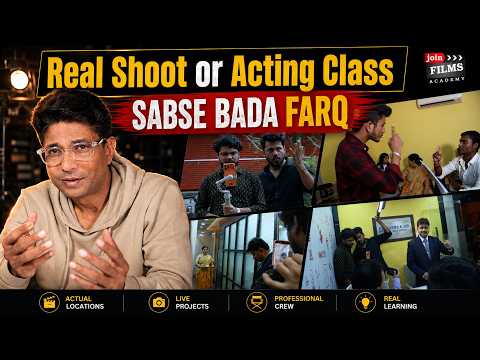
Watch: On-Location Camera Acting — Mistakes New Actors Make
A raw, behind-the-scenes look at the specific mistakes new actors make on an actual shoot — and what separates classroom training from real set experience:
Why Classroom Training Doesn't Always Transfer to Set
A pattern worth understanding directly: skills taught clearly in an acting classroom are often the exact things that get missed on a real shoot. This isn't a contradiction — it reflects a genuine gap between controlled practice and live production pressure.
- Real sets move faster than rehearsal rooms. There is less time to think, more people watching, and genuine consequences for delay — all of which increase the likelihood of reverting to unconscious habits rather than trained technique.
- Equipment and crew introduce new variables. Marks, boom mic positioning, continuity supervisors, and multiple camera angles are rarely fully simulated in a classroom setting.
- Emotional pressure is different with a real crew watching. Performing for a teacher and a handful of classmates is a fundamentally different psychological experience from performing in front of a full production crew and a rolling camera.
This is precisely why practical, on-set training experience — not just classroom scene study — makes such a measurable difference in how quickly a new actor becomes genuinely set-ready.
Watch: Camera Acting = Feel + Control
A focused breakdown of the balance every camera actor needs — genuine feeling combined with technical control, and why overacting fails specifically on camera:
How to Prevent These Mistakes Before They Happen
The reassuring truth: Every mistake on this list is a training gap, not a talent limitation. New actors who receive specific, camera-focused correction on these exact points typically resolve most of them within a few sessions of deliberate, guided practice — this is not a slow, mysterious process.
Why an Experienced Mentor Catches What Self-Practice Misses
Many of these mistakes are genuinely difficult for an actor to notice in themselves — not because they lack self-awareness, but because habits that feel completely natural from the inside often look very different on camera. This is precisely why self-practice alone, however diligent, has real limits.
An experienced mentor watching your work brings two things self-practice cannot replicate: a trained eye that has seen these exact mistake patterns hundreds of times across different students, and the ability to give you specific, actionable correction in the moment rather than a vague sense that "something felt off." A mentor who has directed and cast actors professionally also understands precisely what a casting director or director is unconsciously reacting to when a performance doesn't land — insight that comes from being on the other side of the camera repeatedly, not from studying acting theory alone.
This is also why watching your own self-tapes back is valuable but incomplete on its own. You already know your intentions going into a scene, which makes it genuinely hard to see your own performance the way a stranger — or a casting director who has never met you — actually will. A second, trained set of eyes closes that gap far faster than repeated solo practice alone ever can.
Training That Addresses These Mistakes Directly — JoinFilms Academy
Frequently Asked Questions
❓ What are the most common mistakes new actors make on camera in India?
The most common mistakes include looking directly into the lens without instruction, projecting at theatrical scale rather than camera scale, forgetting their floor mark, breaking continuity between takes, arriving unprepared on lines, and reacting defensively to director's notes.
❓ Why do new actors keep looking into the camera lens?
This is usually an instinctive habit rather than a conscious choice, especially for actors without prior camera-specific training. It is corrected through deliberate eyeline discipline practice — training yourself to focus consistently on your scene partner or mark rather than the lens.
❓ Why does theatre training sometimes cause problems on a film set?
Theatre training develops projection and scale suited to a large hall with distant audiences. Camera work — especially close-up shots on OTT and film — requires a much smaller, more internal scale of performance. Without specific camera training, this transition doesn't happen automatically.
❓ What is a mark in film acting and why does it matter?
A mark is a piece of tape on the floor showing an actor's exact position for correct lighting, framing, and focus. Missing your mark creates technical problems and often requires expensive retakes, which is why hitting it consistently is treated as a basic professionalism skill.
❓ How long does it take to correct common on-camera acting mistakes?
Most of these mistakes are training gaps rather than deep-seated habits, and typically improve significantly within a few sessions of deliberate, camera-focused correction with proper feedback — not months of unclear practice.
❓ Can self-tape practice at home help prevent on-set mistakes?
Yes, significantly. Weekly self-tape practice builds camera scale awareness, reduces self-consciousness in front of a lens, and develops the habit of natural, contained performance — directly addressing several of the most common mistakes new actors make on their first real sets.
About the Author — Virendra Rathore
Virendra Rathore is the Founder and Chief Mentor of JoinFilms Academy. A Dadasaheb Phalke Film Foundation Award winner (Best Acting Mentor), IMDb-credited filmmaker, TEDx speaker, and bestselling author of the "Switch On Switch Off Acting Method," he brings over 25 years of active experience across acting, direction, and film education. Creator of JoinFilms — one of India's largest acting education communities, with over 2.9 million YouTube subscribers.
IMDb profile.
Career Guidance: Get Free Bollywood Career Guidance →
Related: How to Become an Actor in India · Self-Tape Audition Guide for Actors in India · Best Acting School in Mumbai · Film Set Par Pehle Din Kya Karein · How OTT Platforms Are Creating New Opportunities for Actors · JoinFilms on YouTube
 Launch your Graphy