
Monologue Practice Tips for Beginners — A Complete Guide (2026)
Updated: July 2026 | By Virendra Rathore, Founder — JoinFilms Academy
Short answer: Effective monologue practice starts with choosing material genuinely suited to your age and type, breaking the piece into emotional beats, fully memorizing before adding emotional choices, and practicing while imagining a specific person you're speaking to. Recording yourself and getting outside feedback are the two most reliable ways to catch what isn't working. A well-practiced monologue should feel owned and genuinely thought in the moment, not recited — reaching that point takes more repetition than most beginners expect.
Why a Strong Monologue Matters More Than You Think
A monologue is often an actor's first real opportunity to demonstrate range, emotional access, and camera presence without a scene partner to lean on. Many auditions, drama school applications, and showcases specifically require one — which means monologue practice is a foundational skill that returns value across an entire acting career, not just a one-time preparation task.
A genuinely well-practiced monologue also builds broader acting skills — beat work, objective clarity, emotional access — that transfer directly to scene work and camera acting generally, making the time invested in monologue practice compound across your entire skill set rather than serving only this one purpose.
How to Choose the Right Monologue
- Choose material genuinely suited to your age and type. A monologue written for a character decades older or younger than you creates an immediate credibility gap, regardless of performance quality.
- Pick something with a clear emotional journey. A monologue that stays in one emotional register throughout gives you less to demonstrate than one with a genuine shift or discovery within it.
- Avoid material that's extremely overused in audition and drama school contexts — casting directors and evaluators who have heard the same piece dozens of times bring less fresh attention to your specific performance of it.
- Make sure you genuinely connect with the content. A monologue you find personally meaningful or interesting is far easier to access truthfully than one chosen purely because it's technically impressive.
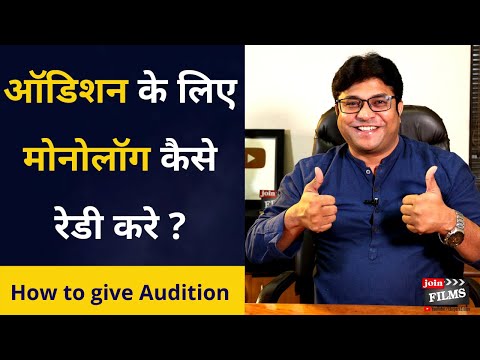
Watch: How to Make a Great Audition Monologue
Virendra Rathore explains how to select and prepare a genuinely effective audition monologue:
7 Steps to Practice a Monologue Effectively
1
Break the Monologue Into Beats
Before memorizing anything, identify the emotional shifts within the monologue — where the character's thinking or feeling changes. Treating a monologue as several connected beats, rather than one continuous block, produces a far more dynamic and truthful performance.
2
Understand the Character's Objective
What does the character want in this specific moment, and from whom? A monologue delivered with a clear, specific objective reads as purposeful and alive. One delivered without this clarity reads as generic recitation, however well the lines are memorized.
3
Memorize Completely Before Adding Emotion
Trying to find emotional truth while still recalling words divides your attention in a way that shows. Get the words fully secure first, so your full attention can go toward genuine performance once you begin adding emotional and physical choices.
4
Practice Speaking to a Specific Imagined Person
Even in a monologue with no visible scene partner, imagining a specific person you're speaking to — and what you need from them — keeps the performance grounded and prevents it from becoming disconnected, generalized emotional display.
5
Record Yourself and Watch It Back Critically
What feels true while performing often looks different on camera. Recording and reviewing is the fastest way to catch choices that aren't actually landing the way they feel internally.
6
Get Outside Feedback, Not Just Self-Assessment
A trained mentor or scene partner catches patterns and habits you cannot see in yourself, however carefully you review your own recordings. Outside feedback consistently accelerates monologue development faster than solo practice alone.
7
Perform It Enough Times That It Feels Owned, Not Rehearsed
There's a specific point in practice where a monologue stops feeling like memorized material and starts feeling like something you're genuinely thinking and saying in the moment. Reaching that point requires more repetition than most actors initially expect.
Common Monologue Mistakes to Avoid
- Playing the ending from the beginning — telegraphing where the emotional journey will end from the very first line, which removes genuine discovery from the performance.
- Generalized, unspecific emotion — playing "sad" or "angry" broadly rather than a specific, personal version of that state grounded in the character's exact situation.
- Rushing through the piece — nervous energy often speeds up delivery in ways that lose clarity and emotional truth, especially in the opening moments.
- Excessive movement or gesture — physical business added to fill perceived dead space, rather than movement that's genuinely motivated by the character's inner state.
- Choosing material for shock value — extremely dark or intense monologues chosen to demonstrate range can backfire if the actor hasn't genuinely earned the emotional depth the piece requires.
Watch: Free Hindi Monologues for Acting Auditions
JoinFilms shares free Hindi monologue material specifically for actors preparing audition pieces:
How Long Should a Monologue Be?
When in doubt, shorter and fully committed almost always outperforms longer and merely adequate — a tightly controlled 45-second piece delivered with complete conviction reads as more skilled than a 3-minute piece that loses focus partway through.
Practical tip: Time yourself during practice, not just during final run-throughs. Nervous energy in an actual audition setting tends to speed up delivery, meaning a monologue that felt correctly timed in relaxed practice may run faster — and therefore differently — when the pressure is real.
Choosing Between Hindi and English Monologues
Indian actors face a specific choice that doesn't come up in many other markets: whether to prepare a monologue in Hindi, English, or both, depending on the casting context.
- For Bollywood, Hindi TV, and Hindi OTT auditions, a genuinely well-performed Hindi monologue is essential — casting directors specifically want to hear how you handle the language and rhythm you'll actually be working in.
- For international, English-language OTT, or crossover auditions, a strong English monologue demonstrates a genuinely different but equally important skill set to casting directors.
- Having both genuinely ready — not one strong piece and one weak backup — significantly expands the range of opportunities you can confidently pursue without any last-minute scrambling to prepare new material under pressure.
Code-switching monologues, which blend Hindi and English naturally within the same piece, are also increasingly common in contemporary Indian casting briefs, reflecting how urban Indian characters actually speak in real life — having at least one piece like this in your repertoire is genuinely valuable.
Building a Monologue Bank for Different Auditions
Rather than preparing a single monologue and reusing it for every opportunity, experienced actors maintain a small, genuinely ready "bank" of pieces across different tones:
Maintaining three or four genuinely rehearsed pieces across these categories means you're never scrambling to prepare something new under time pressure when an unexpected opportunity arrives with short notice, which happens more often in this industry than most beginners anticipate.
Building Monologue Skills — JoinFilms Academy
Frequently Asked Questions
❓ How do I practice a monologue effectively?
Break the monologue into emotional beats, understand the character's objective clearly, memorize completely before adding emotional choices, practice speaking to a specific imagined person, and record yourself for critical review alongside outside feedback.
❓ How do I choose the right monologue for an audition?
Choose material genuinely suited to your age and type, with a clear emotional journey rather than one flat register, avoid extremely overused pieces, and select something you personally connect with rather than purely technically impressive material.
❓ How long should an audition monologue be?
Film and OTT self-tape monologues typically run 30-90 seconds, drama school auditions often want 1-2 minutes, and showcase performances may run 2-3 minutes. Shorter and fully committed almost always outperforms longer and merely adequate.
❓ What are common mistakes actors make with monologues?
Common mistakes include playing the emotional ending from the very beginning, generalized rather than specific emotion, rushing through the piece from nerves, excessive unmotivated movement, and choosing material for shock value rather than genuine connection.
❓ Should I get feedback on my monologue before an audition?
Yes. A trained mentor or scene partner catches patterns and habits you cannot see in yourself, even after careful self-review. Outside feedback consistently accelerates monologue development faster than solo practice alone.
❓ Should Indian actors prepare monologues in both Hindi and English?
Yes, ideally. Hindi monologues are essential for Bollywood, Hindi TV, and Hindi OTT auditions, while English monologues matter for international or crossover opportunities. Having both genuinely ready expands the range of auditions you can confidently pursue without scrambling to prepare new material.
About the Author — Virendra Rathore
Virendra Rathore is the Founder and Chief Mentor of JoinFilms Academy. A Dadasaheb Phalke Film Foundation Award winner (Best Acting Mentor), IMDb-credited filmmaker, TEDx speaker, and bestselling author of the "Switch On Switch Off Acting Method," he brings over 25 years of active experience across acting, direction, and film education. Creator of JoinFilms — one of India's largest acting education communities, with over 2.9 million YouTube subscribers.
IMDb profile.
Career Guidance: Get Free Bollywood Career Guidance →
Related: How to Crack a Bollywood Audition · How to Give an Audition for Movies · Self-Tape Audition Guide for Actors in India · Voice Modulation and Diction for Actors · Camera Ke Samne Confident Kaise Dikhein · JoinFilms on YouTube
 Launch your Graphy