Updated: November 2026 | By Virendra Rathore, Founder — JoinFilms Academy
Short answer: To avoid overacting, stop showing the emotion and start thinking the character's thought. The camera reads thoughts through your eyes, so a close-up needs far less face, voice and hand movement than a stage. Match your energy to the shot size, listen to your co-actor instead of waiting for your line, cut every gesture that has no reason, and record yourself so you can see the difference between feeling and pushing. Natural acting is not "doing less" — it is doing only what is true for the moment.
Every casting director in Mumbai has said some version of this line: "Thoda kam karo." Less. Softer. More real. If you have heard it after an audition, you are not alone — learning how to avoid overacting is the single most common correction new actors receive, especially those who come from school plays, nukkad natak or reels where everything has to be loud to land. This guide explains what overacting actually is, why it happens, how to avoid overacting with seven practical fixes, and a 15-minute exercise you can do at home before your next self-tape.
What Overacting Really Means on Camera
Overacting — also called hamming, mugging or "chewing the scenery" — is exaggerated acting, where the performance becomes bigger than the truth of the moment. Wikipedia's entry on overacting notes that even Al Pacino argued all actors overact to some degree, because "in the theater you have to reach the balcony."
That is the core of the problem. On stage, the audience in the last row is 60 feet away, so the voice, gestures and expressions are scaled up. On a film set, the camera may be 3 feet from your face, and in a close-up your eye is the size of a television screen. Whatever you push, the lens magnifies. A raised eyebrow that looks normal in a theatre looks like a cartoon in a close-up.
If you want to avoid overacting, understand this first: overacting on camera usually is not "too much emotion." It is too much demonstration of emotion — the actor is showing the audience that they are sad, angry or shocked instead of simply being in that state and letting the camera find it.
Why New Actors Overact: 6 Root Causes
You cannot avoid overacting by simply telling yourself to "act less." Most actors who try that become flat and lifeless. You have to fix the cause. In our classes, these six causes appear again and again:
- Fear of not being seen. Nervous actors think that if they do not do something visible, the casting team will think they did nothing.
- Stage habits. Theatre and nukkad natak training builds projection — a valuable skill that needs to be resized for the lens.
- Imitating TV serial or reel styles. Some daily soaps and short-form videos use heightened reactions on purpose. Copying them in a film audition reads as false.
- Playing the result, not the situation. "I have to cry here" leads to pushing. "My father just ignored my call on my wedding day" leads to truth.
- Not listening. When you are only waiting for your cue, your reactions are pre-planned, and pre-planned reactions are always a little too big.
- No feedback loop. Most beginners never watch their own footage, so they have no idea how their face actually reads on screen.
Avoid Overacting by Matching Energy to Shot Size
Here is a working guide we use with students. It is not a rule from a textbook — it is a practical scale to help you avoid overacting by adjusting your output to the frame. Always ask the director or assistant director what the shot size is before a take; knowing the frame is the easiest way to avoid overacting.
Notice that the emotion stays the same in every row — you avoid overacting without losing feeling. Only the size of the expression changes. That is the real secret of camera acting: the inside stays at 10, the outside scales to the frame.
How to Avoid Overacting: 7 Fixes That Work on Set
These are the corrections I give most often in camera acting class. Practise them one at a time, not all together. Each one helps you avoid overacting from a different direction.
- Find the thought behind every line. Before each dialogue, write in one sentence what your character wants from the other person. When you are busy wanting something, your face stops performing.
- Listen like it is the first time. Really hear your co-actor's line, even in the tenth take. A genuine reaction is smaller and more interesting than a planned one.
- Cut unmotivated gestures. Rehearse once with your hands completely still. Then add back only the gestures that feel necessary. You will usually keep fewer than half — and that alone helps you avoid overacting in medium shots.
- Relax the forehead. Most camera overacting lives in the eyebrows. Put a finger lightly on your forehead during rehearsal; if it moves on every line, that is your warning sign.
- Use pauses, not volume. Silence before an important line carries more weight than shouting it. In a close-up, a held look often says what the dialogue cannot.
- Bring the voice to conversation level. The boom mic is close. Speak to the person in front of you, not the back wall. Our guide on voice modulation (linked below) goes deeper on this.
- Watch your footage, then do one adjustment. Record every scene you practise. Watch it once with sound and once without. Without sound, overacting is impossible to miss, and you learn to avoid overacting by seeing it yourself.
Video: 4 Tips for Natural Acting
In this JoinFilms video, Virendra Rathore talks about fully accepting a character, trusting your instincts and staying open to change, and how the Switch On Switch Off method helps an actor stay natural on camera.
Practical Exercise to Avoid Overacting in Auditions
This is a 15-minute drill you can do with only a phone and a short scene of four to six lines. Do it three times a week for a month and you will see a clear change in your self-tapes.
- Take 1 — Full out (3 min). Perform the scene as big as you instinctively want. Record it in a close-up frame.
- Take 2 — Hands still, forehead still (3 min). Same scene, but hands rest by your side and your eyebrows do not move. Let only your eyes and breath carry the scene.
- Take 3 — Thought only (3 min). Say the lines almost at a whisper, as if the other person is sitting on your bed. Think the subtext clearly before each line.
- Review (6 min). Watch all three takes on mute. Note which one you actually believe. Most actors pick Take 2 or Take 3 — and are surprised that it did not feel like "enough" while performing.
The lesson: what feels like enough to you is often too much for the camera. Trust the footage, not the feeling. Repeating this exercise is one of the most reliable ways to avoid overacting before it reaches a casting director's screen.
Honest note: Do not swing to the opposite extreme. Many actors who are told to "tone it down" start mumbling, freezing their face and holding back all energy. That is underacting, and it gets rejected just as fast. The goal when you avoid overacting is truthful, not small. Your energy stays alive inside; only the outer size adjusts to the frame.
Video: The Mistake 90% of Actors Make
This JoinFilms Academy masterclass explains why acting is more than delivering dialogue — covering character background, facial expressions, body language, voice modulation and scene analysis, with student practice sessions.
When "Big" Acting Is the Right Choice
Learning to avoid overacting does not mean every performance must be tiny. Some genres ask for a bigger style — broad comedy, stylised villains, fantasy, musicals and certain mass-entertainment films. The same Wikipedia entry records that Jim Carrey's breakthrough roles in Ace Ventura: Pet Detective and The Mask (both 1994) were flamboyant because the scripts required it, and that Gary Oldman has said the screen "can hold the epic, and it can hold the very, very small" if it comes from a sincere place.
The difference between a big performance and overacting is simple: a big performance is still truthful to the character and the world of the film. Overacting is big without a reason. Before you go large, ask two questions — does the script demand it, and has the director asked for it? If the answer to both is yes, commit fully. If not, scale down.
For comic and villain roles, read our comedy acting guide below; timing and intention matter far more than loud expressions.
These JoinFilms guides go deeper into the skills that help you stay natural:
Courses That Train Natural Camera Acting
Reading helps, but natural acting is built through repetition in front of a camera with feedback from a mentor. These JoinFilms Academy courses focus on that practice. No course can guarantee work — what they give you is structured training and honest correction.
FAQs
❓ How do I avoid overacting in front of the camera?
Focus on what your character wants instead of showing the emotion, match your expression size to the shot, keep your forehead and hands relaxed, and really listen to your co-actor. Recording yourself and watching on mute is the fastest way to spot where you are pushing.
❓ Is overacting always bad?
No. Broad comedy, stylised villains and some mass-entertainment films call for a bigger style. It becomes a problem when the performance is bigger than the truth of the scene or bigger than what the director wants.
❓ Why do theatre actors overact on camera?
Theatre trains actors to project to the last row. The camera is much closer, so the same projection looks exaggerated. Theatre actors usually adapt quickly once they learn to keep the inner energy high and reduce the outer size.
❓ What is the difference between overacting and underacting?
Overacting pushes expressions beyond the truth of the moment. Underacting holds back so much that the audience cannot read any thought. Natural acting sits between them: a clear, alive thought expressed at the size the frame needs.
❓ How can I avoid overacting in a self-tape audition?
Frame yourself chest up, place your reader just beside the lens, keep your eyeline on the reader, and speak at conversation volume. Do two or three takes at different energy levels and send the one that looks most believable on mute.
❓ How long does it take to stop overacting?
It varies by actor. With regular recorded practice and feedback, many students notice a clear difference within a few weeks, but camera instinct keeps improving over years of work.
❓ Can an acting course help me act more naturally?
A good camera acting course gives you repeated practice in front of a lens and honest feedback, which is what builds natural acting. It cannot guarantee roles, but it shortens the trial-and-error phase.
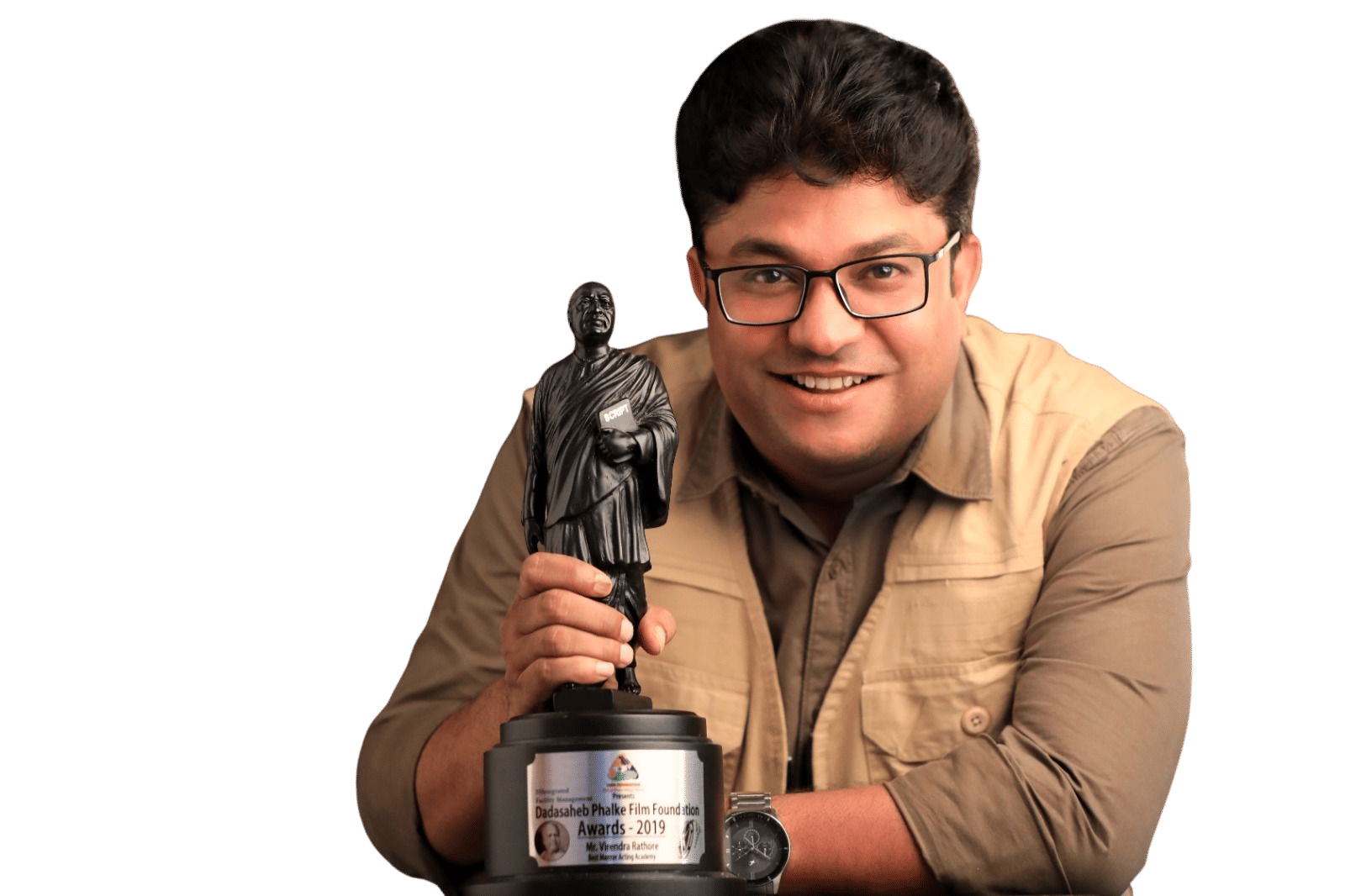
About the Author — Virendra Rathore
Virendra Rathore is the Founder and Chief Mentor of JoinFilms Academy. A Dadasaheb Phalke Film Foundation Award winner (Best Acting Mentor), IMDb-credited filmmaker, TEDx speaker, and bestselling author of the "Switch On Switch Off Acting Method," he brings over 25 years of active experience across acting, direction, and film education. Creator of JoinFilms — one of India's largest acting education communities, with over 2.9 million YouTube subscribers.
IMDb profile.
Career Guidance: Get Free Bollywood Career Guidance →
Sources: Wikipedia — Overacting; JoinFilms YouTube videos embedded above. Related: On-camera mistakes · Monologue practice tips · Memorize dialogues

 Launch your Graphy