Updated: November 2026 | By Virendra Rathore, Founder — JoinFilms Academy
Short answer: Good facial expressions for acting come from thought, not from muscles. On camera, especially in a close-up, the lens records tiny changes in the eyes, brows and mouth, so a "big" theatre face looks false. The working method is simple: know exactly what your character wants in the moment, let that thought reach the eyes first, keep the rest of the face relaxed, and check yourself on a phone camera instead of a mirror. Practise one emotion at a time, at three sizes (small, medium, large), and always rehearse with a real reason behind every look.
What Are Facial Expressions for Acting, Really?
Most beginners think facial expressions for acting means making a "sad face", an "angry face" or a "happy face" on command. That is the first trap. In real life nobody decides to make a face. A face changes because a thought or a feeling has already happened inside. The face is the result, not the starting point.
So when a casting director watches your audition or self-tape, they are not grading your eyebrows. When they judge facial expressions for acting, they are asking one question: is this person thinking right now? If the answer is yes, even a still face can hold the screen. If the answer is no, the most dramatic expression in the world looks like a mask.
Researchers have studied the face in detail for over a century. The Facial Action Coding System, published by psychologists Paul Ekman and Wallace V. Friesen in 1978, breaks every visible movement of the face into numbered "action units", each linked to a muscle or a group of muscles (Wikipedia). You do not need to memorise any of it. The useful lesson for actors is this: the face has many small, separate parts, and real emotion rarely moves all of them at once.
Why the Camera Changes Everything
On a stage, an actor has to reach the last row of the auditorium. Gestures, voice and expression are scaled up so that people far away can read them. On a film set, the camera may be less than a metre from your face. In a close-up, your face fills a cinema screen or a phone screen, and every small twitch becomes visible.
This is why so many talented theatre and nukkad natak performers look "too much" in their first camera audition. Nothing is wrong with their talent. Their size is wrong for the frame. Camera-ready facial expressions for acting keep the same inner intensity but shrink the outer signal.
Film history also tells us how much the audience adds on its own. In the 1910s and 1920s, Russian filmmaker Lev Kuleshov cut the same expressionless shot of actor Ivan Mosjoukine against a bowl of soup, a girl in a coffin and a woman on a divan. Viewers believed they saw hunger, grief and desire, although the face footage was identical each time (Wikipedia — Kuleshov effect). The lesson is not "do nothing". It is that the edit, the story and the context already do a lot of work, so you do not need to push your facial expressions for acting.
Watch: Facial Expressions for Acting — Free Class by Virendra Rathore
In this free class from the JoinFilms channel, Virendra Rathore walks through how actors can work on facial expressions for acting in a practical way. Watch it once fully, then watch again and pause after each point to try it yourself on your phone camera.
The Navarasa and the Face: An Indian Map of Emotion
Indian performers have a ready-made emotion map that is older than cinema itself. The Natya Shastra, attributed to Bharata Muni, describes eight rasas, and later authors added a ninth, Shanta, to make the nine rasas or Navarasa (Wikipedia — Rasa). Classical dance shows them with large, stylised expressions. For the camera, facial expressions for acting keep the emotion and reduce the size.
The table below is our own teaching guide. It shows where each rasa usually "lives" on the face and the most common mistake new actors make with it on camera.
Notice a pattern: almost every fix asks you to do less on the outside and think more clearly on the inside.
7 Lessons to Build Facial Expressions for Acting
Here is the step-by-step approach to facial expressions for acting that we use with students. Work through these in order; each one builds on the last.
- Start with a thought, not a face. Before any line, decide what your character wants from the other person. "I want him to admit he lied" gives your face something to do. "Look angry" gives it nothing.
- Relax the face as your base. Tension in the forehead, jaw or lips reads as nervousness on camera. Before every take, release your jaw, soften your brows and breathe out slowly.
- Lead with the eyes. In a close-up the eyes carry most of the story. A real smile, known as a Duchenne smile, involves the muscle around the eyes as well as the mouth, which is why a mouth-only smile looks fake (Wikipedia — Duchenne smile).
- Practise three sizes. Do each emotion at a small, medium and large size. Learn which size suits a close-up, a mid shot and a wide shot. Most beginners only own the large size.
- Listen with your face. Many of your best moments on screen are reaction shots. Hear the other actor's line as if for the first time and let it change you.
- Allow mixed emotions. Real people smile while hurting and laugh while scared. A face that shows two things at once is more interesting than a "pure" emotion.
- Record, don't mirror. A mirror makes you watch yourself while acting, which kills truth. Record on a phone, act fully, then review afterwards like a director.
These lessons are the foundation of good facial expressions for acting, and they connect directly to how you avoid overacting on set.
Watch: Camera vs Theatre Acting — Key Differences
This short video from the JoinFilms channel explains the difference between performing for a stage and performing for a lens. Keep the "size" idea from this blog in mind while you watch.
Practical Exercise: The 10-Day Mirror-to-Phone Drill
This drill trains facial expressions for acting without any special equipment. You need only a phone, a stand or a stack of books, and ten to fifteen minutes a day.
Days 1–3: Neutral and relaxed
Frame yourself in a close-up at eye level. Record 30 seconds of simply sitting and thinking about your day. Watch it back. Note where you hold tension: jaw, forehead, lips. Repeat until your neutral face looks calm and alive.
Days 4–7: One emotion, three sizes
Pick one rasa from the table each day. Imagine a specific, personal situation. Record it small, then medium, then large, with the same thought each time. Compare the clips. Usually the small version reads best in a close-up.
Days 8–10: The reaction shot
Ask a friend to read you a short piece of news from a script, or play a recorded line. Do not speak. Only listen and react. Then try a short dialogue from a scene you like and act it fully. Review the clips like a casting director: where did you believe yourself, and where did you "show"?
Keep all your clips. After ten days you will have a clear before-and-after record, and a few good takes might even become material for your showreel later.
Common Mistakes Beginners Make
- Copying a star's expression. This is the most common error in facial expressions for acting. Imitating a famous actor's look gives you their shape without their thought. Use them for inspiration, not as a template.
- Telegraphing. Showing the emotion before the other actor's line has landed. React after you hear, not before.
- Constant eyebrow movement. Brows that move on every word read as overacting in a close-up.
- Blinking to escape. Nervous blinking breaks eye contact and weakens intense moments. Steady eyes feel stronger.
- Freezing after the line. Your face should keep thinking after you finish speaking; editors often use those seconds.
Honest note: No exercise or course can give you "perfect expressions" in a week, and no institute can promise you a role. Expressive, truthful acting is a skill that grows through steady practice, feedback and real camera time. What training can do is shorten your learning curve and show you your blind spots faster.
Further Reading on JoinFilms
If you are working on facial expressions for acting, these related guides will help you go deeper:
Courses to Train Facial Expressions for Acting
If you want structured practice with feedback on camera, these JoinFilms Academy programmes cover facial expressions for acting, camera presence and dialogue delivery as part of a wider acting syllabus.
Frequently Asked Questions
❓ How can I improve my facial expressions for acting at home?
Record yourself on a phone in a close-up every day. Practise one emotion at three sizes, always with a specific thought behind it, and review the clips afterwards. Relax your jaw and forehead before each take.
❓ Should I practise expressions in front of a mirror?
A mirror is fine for checking tension, but not for acting. Watching yourself while performing pulls you out of the moment. A phone camera lets you act fully first and judge later.
❓ Why do my expressions look fake on camera?
Usually because the face is moving without a thought behind it, or the size is too big for the frame. Decide what your character wants, lead with the eyes and reduce outer movement.
❓ Are facial expressions for acting different on stage and on screen?
Yes. The inner emotion stays the same, but the stage needs bigger signals for a distant audience, while the camera picks up tiny changes, especially in close-ups.
❓ What are the nine rasas, and do actors still use them?
The Navarasa are Shringara, Hasya, Karuna, Raudra, Veera, Bhayanaka, Bibhatsa, Adbhuta and Shanta. Many Indian actors use them as an emotion vocabulary, then scale them down for camera.
❓ How long does it take to get better at expressions?
Most learners notice a difference within a few weeks of daily recorded practice, but real control grows over months of scene work and feedback. There is no fixed timeline.
❓ Do casting directors judge expressions in an audition?
They look for truthful reactions and clear thinking, not for "perfect" faces. A calm, alive face that listens well often stands out more than dramatic expressions.
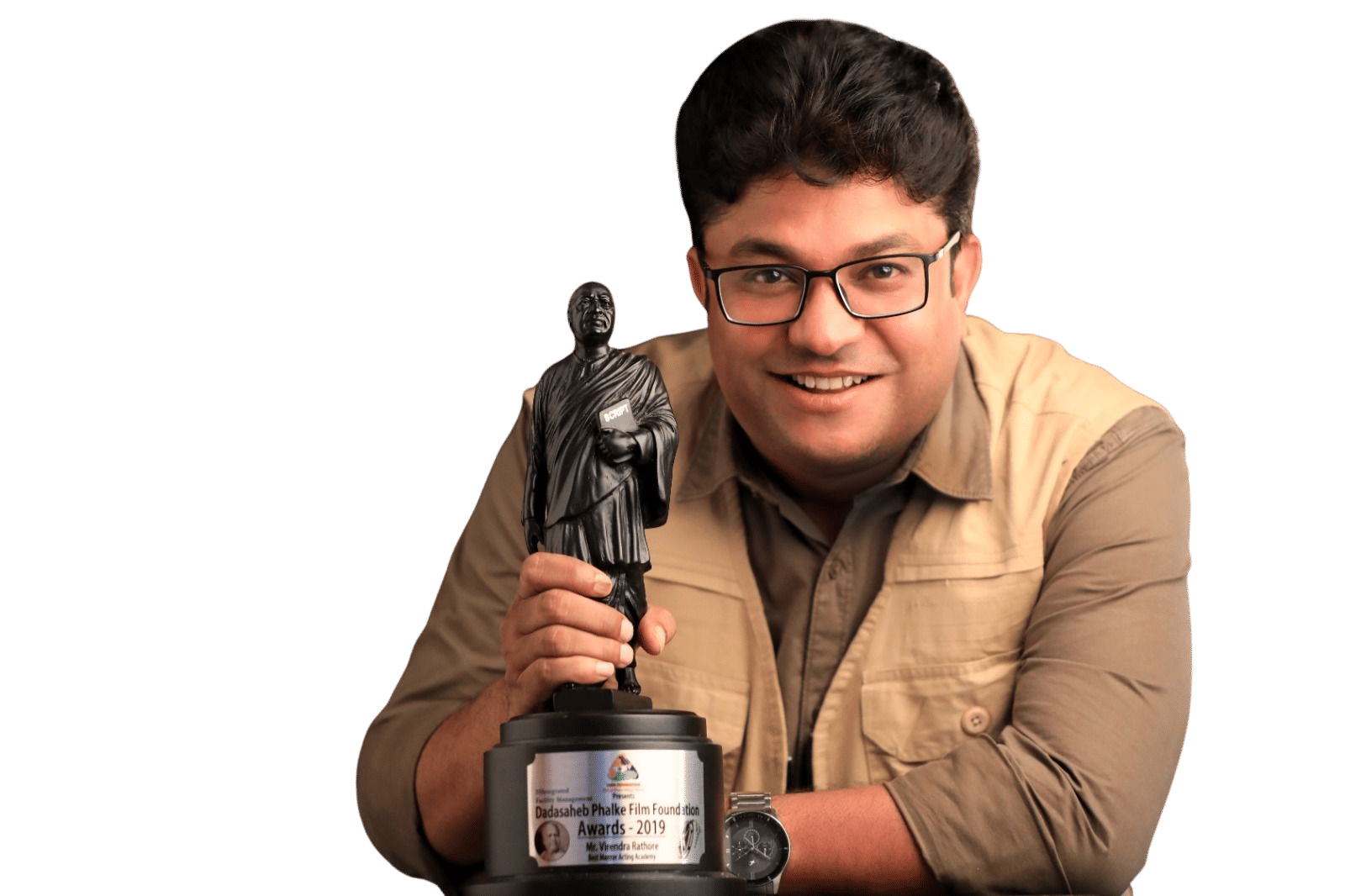
About the Author — Virendra Rathore
Virendra Rathore is the Founder and Chief Mentor of JoinFilms Academy. A Dadasaheb Phalke Film Foundation Award winner (Best Acting Mentor), IMDb-credited filmmaker, TEDx speaker, and bestselling author of the "Switch On Switch Off Acting Method," he brings over 25 years of active experience across acting, direction, and film education. Creator of JoinFilms — one of India's largest acting education communities, with over 2.9 million YouTube subscribers.
IMDb profile.
Career Guidance: Get Free Bollywood Career Guidance →
Sources: Facial Action Coding System, Kuleshov effect, Duchenne smile, Rasa (aesthetics) — Wikipedia. Related: How to Avoid Overacting · Natural Acting for Camera

 Launch your Graphy