
How to Become an Assistant Director in India (2026)
Updated: July 2026 | By Virendra Rathore, Founder — JoinFilms Academy
Short answer: Becoming an assistant director in India typically starts with working as a production assistant or trainee to build genuine on-set experience, then developing strong organizational, scheduling, and people-management skills that the role fundamentally requires. Assistant directing is primarily a production management job, not a creative directing role — understanding this distinction early prevents a common misconception that derails many newcomers' expectations and career planning.
What Does an Assistant Director Actually Do?
Despite the title, an assistant director in India rarely makes creative directing decisions. The role is centered on production logistics — creating and managing shooting schedules, coordinating between departments, keeping the set running on time, and ensuring the director's creative vision can actually be executed well within the practical constraints of budget and schedule.
This distinction matters enormously for anyone considering this path. Aspiring filmmakers who pursue AD work expecting creative involvement similar to directing often find the reality quite different — and understanding this upfront leads to a much more realistic, successful pursuit of the role, rather than disappointment and early burnout once the actual day-to-day work becomes clear.
Understanding the AD Hierarchy
Most careers in assistant directing begin at the trainee or 3rd AD level and progress upward through demonstrated reliability and growing responsibility across multiple productions, rather than through any formal promotion process or fixed timeline that applies uniformly across the industry.
Watch: How to Become an Assistant Director
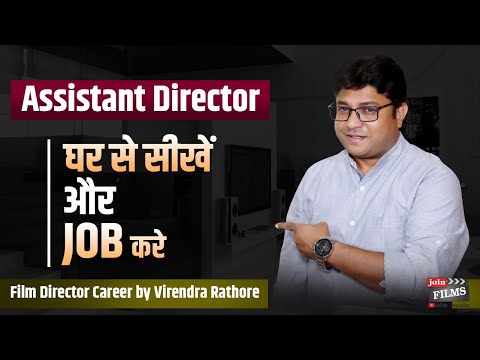
Virendra Rathore breaks down the realistic path to becoming an assistant director in the Indian film industry:
6 Steps to Become an Assistant Director in India
1
Understand the Role Before Pursuing It
Assistant directing is fundamentally a production management role, not a creative directing role in the way many newcomers assume. It involves scheduling, coordination, and keeping the entire set running on time — genuinely different work from what the title might suggest to someone outside the industry.
2
Start as a Production Assistant or Trainee
Almost no one enters directly as an assistant director. Most working ADs in India started as production assistants or trainees on set, learning the practical rhythm of a shoot from the ground level before ever taking on genuine AD responsibilities.
3
Build Genuine On-Set Experience
There is no substitute for time spent on actual film sets. Volunteering on student films, short films, or independent productions — even unpaid initially — builds the practical understanding that no classroom alone can genuinely provide to a new filmmaker.
4
Develop Strong Organizational and People Skills
The job is fundamentally about managing people, time, and logistics simultaneously under pressure. Actors and directors get the creative credit, but a production runs on the AD's ability to keep dozens of moving parts coordinated at once, every single day of the shoot.
5
Learn Industry-Standard Scheduling Tools and Practices
Familiarity with shooting schedules, call sheets, and production breakdowns — the practical paperwork of filmmaking — is genuinely expected knowledge, not something picked up casually on the job for most serious productions today.
6
Build a Reputation for Reliability From Day One
Because ADs are trusted with keeping an entire production on schedule, reliability and calm under pressure are valued even more than in most other film roles. This reputation, built project by project, is genuinely what leads to being called back for larger, more prestigious productions.
Skills Every Assistant Director Needs
- Exceptional organization — juggling schedules, call times, and logistics across dozens of people simultaneously without things falling through the cracks.
- Calm communication under pressure — production days are inherently stressful, and an AD who stays composed while communicating clearly keeps the entire set functional.
- Understanding of every department's basic needs — camera, lighting, sound, costume, and cast all have different scheduling requirements that an AD must genuinely account for all at once.
- Diplomatic authority — ADs often need to enforce schedule and set discipline without formal creative authority, requiring a specific interpersonal skill of commanding respect through competence rather than title, especially when working with senior cast or crew members who outrank them formally.
Watch: What Does an Assistant Director Do — Full Details
A complete breakdown of the assistant director's day-to-day responsibilities on an actual film production:
What Assistant Directors Earn in India
These figures vary significantly based on production budget, whether the project is a film, OTT series, or television production, and the specific city and production house involved — Mumbai-based productions with larger budgets typically pay meaningfully more than smaller regional productions.
Fraud warning: No legitimate production ever charges someone money to work as a production assistant or trainee assistant director. Any "training program" requiring payment to guarantee an AD position on a real production should be treated with serious caution.
Common Mistakes New Assistant Directors Make
- Expecting creative input too early. New ADs sometimes offer unsolicited creative opinions to the director, which is generally unwelcome from someone in a production management role — the AD's job is execution, not creative direction, especially early in a career.
- Underestimating the administrative workload. Many newcomers focus on the on-set visibility of the role and are caught off guard by the significant behind-the-scenes paperwork — schedules, call sheets, department coordination — that consumes much of an AD's actual time.
- Poor communication under pressure. Production days are inherently stressful, and ADs who become visibly frazzled or communicate unclearly during high-pressure moments quickly lose the trust of directors and department heads.
- Not building relationships across departments. Effective ADs maintain working relationships with every department — camera, sound, costume, cast — since the role fundamentally depends on coordinating between all of them smoothly, and those relationships are what make coordination genuinely possible under time pressure.
Assistant Directing as a Path Toward Becoming a Director
Many working directors in India, including several well-known names, began their careers as assistant directors — and this remains one of the most reliable, if gradual, paths into directing itself. The reasoning is straightforward: AD work provides direct, practical exposure to exactly how a production actually runs, in a way that film school theory alone genuinely cannot fully replicate for a new filmmaker.
Spending time as an AD teaches the practical mechanics of translating a script into an actual shooting schedule, managing the countless small decisions that occur on any given production day, and understanding the real constraints — budget, time, crew capacity — that any director eventually has to work within. Many aspiring directors specifically choose to spend several years as an AD deliberately, treating it as an apprenticeship rather than simply a job, before stepping into directing roles themselves — building both the practical skills and the industry relationships that make a genuine directing career possible down the line.
Building AD-Ready Skills — JoinFilms Academy
Frequently Asked Questions
❓ How do I become an assistant director in India?
Start as a production assistant or trainee to build genuine on-set experience, then develop the organizational and people-management skills the role requires. Most working ADs in India began at the trainee level and progressed through demonstrated reliability across multiple productions.
❓ What does an assistant director actually do on a film set?
An assistant director manages production logistics — creating shooting schedules, coordinating between departments, keeping the set on time, and ensuring the director's vision can be executed within budget and schedule constraints, rather than making creative directing decisions.
❓ Do I need a film school degree to become an assistant director?
No formal degree is strictly required. Practical on-set experience, starting as a production assistant or trainee, is generally more valued by productions than academic credentials alone for this specific role.
❓ How much do assistant directors earn in India?
Trainee and 3rd AD roles typically earn Rs 10,000 to Rs 25,000 per month, 2nd ADs earn Rs 25,000 to Rs 60,000, and experienced 1st ADs can earn Rs 60,000 to over Rs 2,00,000 per project, depending on production budget and scale.
❓ Is assistant directing a good path toward becoming a full director?
Yes, for many filmmakers. Assistant directing provides direct, practical exposure to how productions actually run, which many directors consider invaluable preparation, though it is a distinct skill set focused on production management rather than creative direction itself.
❓ What is the most common mistake new assistant directors make?
Offering unsolicited creative input to the director too early is one of the most common mistakes. The AD's role is production execution, not creative direction, and new ADs who blur this line often struggle to build trust with directors and crew.
About the Author — Virendra Rathore
Virendra Rathore is the Founder and Chief Mentor of JoinFilms Academy. A Dadasaheb Phalke Film Foundation Award winner (Best Acting Mentor), IMDb-credited filmmaker, TEDx speaker, and bestselling author of the "Switch On Switch Off Acting Method," he brings over 25 years of active experience across acting, direction, and film education. Creator of JoinFilms — one of India's largest acting and filmmaking education communities, with over 2.9 million YouTube subscribers.
IMDb profile.
Career Guidance: Get Free Bollywood Career Guidance →
Related: How to Become a Filmmaker in India · How to Become a Script Writer in India · Junior Artist Career in India · Film Set Par Pehle Din Kya Karein · Best Online Filmmaking Workshop in Mumbai · JoinFilms on YouTube
 Launch your Graphy